
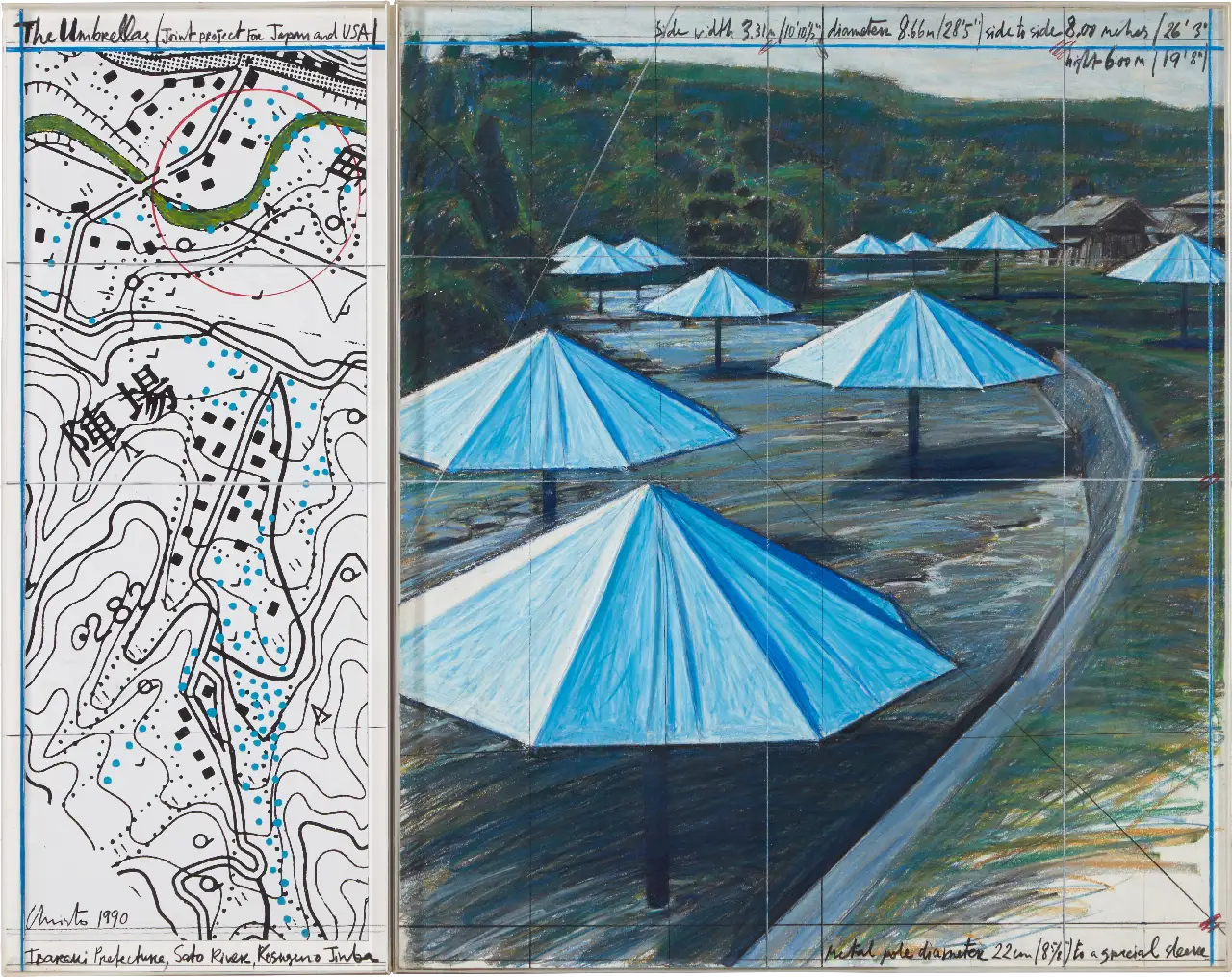
The project The Umbrellas was conceived in 1984, and the production of sketches for the imagined object continued between 1984 and 1991. Yellow umbrellas for California, blue for Japan. This preparatory work from 1990, depicting the blue umbrellas for the Japanese site, bears witness to the final phase of the project’s conception. Combining pencil, pastel, charcoal, enamel paint, and a topographic map, it anchors the artistic vision in the geographic reality of the Sato River valley.
Blue was chosen for Japan in response to its environment and climate : unlike California’s aridity, the Ibaraki region benefits from lush vegetation and verdant rice fields. The umbrellas are thus likened to a vegetal “population,” whose color code is tied to the biotope.
The Japanese site, in the riverbed and on the slopes of the Sato River, hosted 1 340 umbrellas
(1)
covering an area of 57 km2.
It required 920 installers.
The project was in place on 9 October 1991
With this project, Christo shifted the very scale of their in situ interventions : gigantism would henceforth become the most spectacular hallmark of their projects and installations—reaching a peak, in 1991, with the doubling of the installation site of The Umbrellas on both sides of the Pacific
“The Umbrellas were seen, approached, and appreciated by the public for 18 days; either from a distance by car, or up close where they lined the roads, or by walking beneath ‘The Umbrellas’ within their luminous shadows.”
Footnotes
- These points are umbrellas with a constant height of six meters and a constant diameter of 8.66 meters, made up of eight triangular fabric panels forming inclined planes radiating from a fixed point of origin—the top of their pole. ↩
- Christo, on the season of installation: “I think autumn is also ideal in Japan because—for practical as well as aesthetic reasons—I would like to use the rice fields. After the rice harvest, when the paddies are no longer planted, I will be free to install the umbrellas there. I will realize the project when it suits the farmers and the residents.” (Yanagi M., 1989, interview with Christo, in exhibition catalogue, Christo from the Lilja Collection, Musée d’art moderne et contemporain, Nice, pp. 176‑203). ↩
- “Why Ibaraki? […] Ibaraki is north of Tokyo, near Narita International Airport. […] The Pacific unites the two sites.” (Christo and Jeanne-Claude, 2000, p. 19). ↩
- Marsaud-Perrodin, 1996, p. 84. ↩
Reference : Christo (1998/a), Christo and Jeanne-Claude, The Umbrellas, Japan‑USA, 1984‑1991, Cologne, Editions B. Taschen, 1422 p. (