
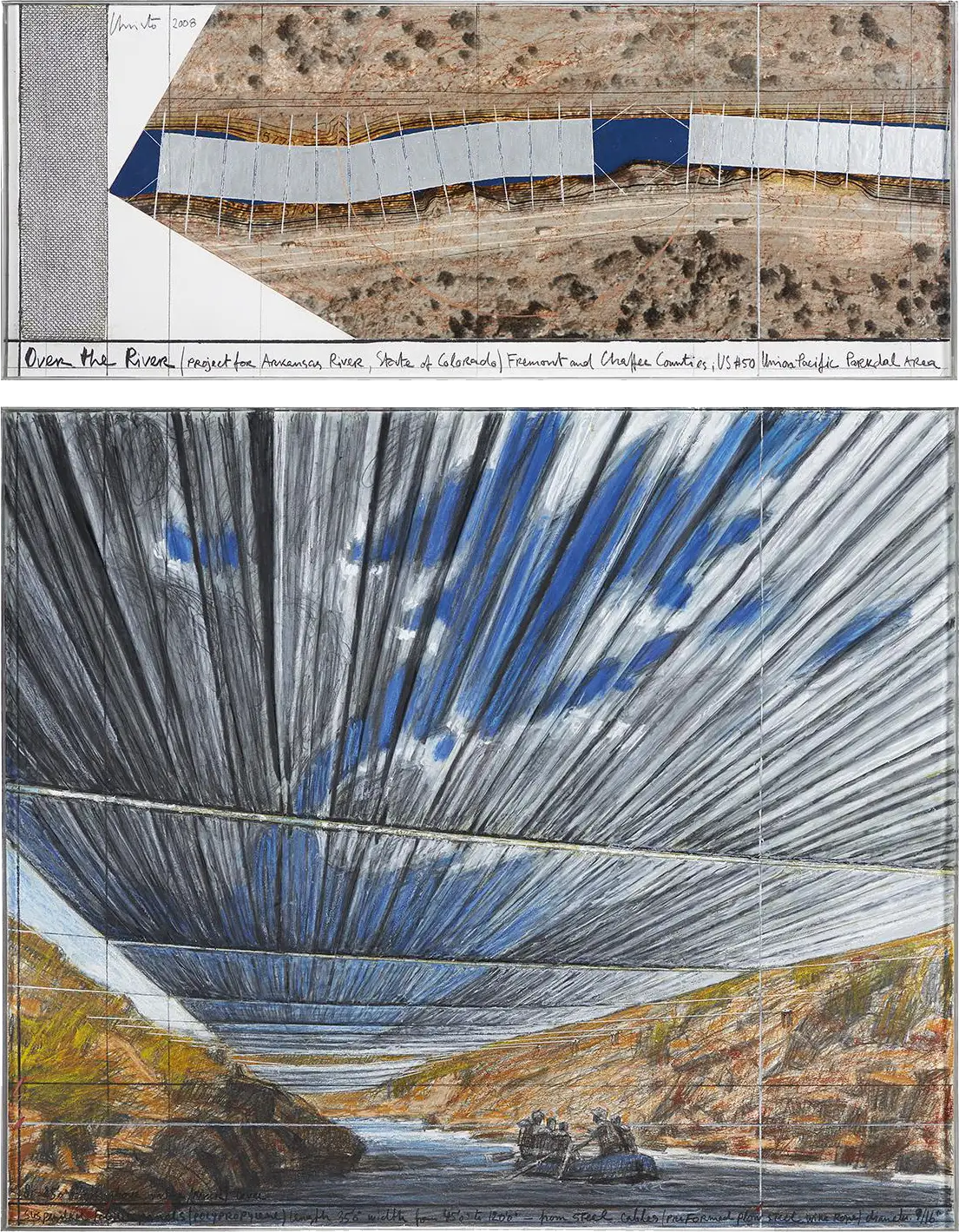
This project was born in 1992 from a smile exchanged seven years earlier between Christo and Jeanne-Claude, as they were directing the Wrapping of the Pont-Neuf in Paris. Amid all the bustle and activity, they experienced the same sense of wonder before the undulating, shimmering fabric reflecting the light of the Seine.
From 1992 to 1994, the couple searched for the ideal site for Over the River. They crossed the Rocky Mountains and explored 89 rivers, selecting only six.
By 1996, they knew it would be the Arkansas River in the State of Colorado: a stretch of nearly 68 km between the towns of Salida and Cañon City. The high banks would make it easier to anchor the steel cables on which the fabric panels would be stretched, far above the waterline, in eight long segments widely spaced to allow natural sunlight through. The outline of each of the eight segments would follow the river’s course exactly.
Full-scale tests began the following year.
There would be four of them, shielded from prying eyes.
During the very first test, held in June 1997, Vince Davenport, the project’s chief engineer, identified 400 things that must never be done
(1).
Subsequent tests took place in September 1997, then in June 1998, and a final one during the summer of
Eighteen panels were required to determine the material, thickness, weave, and color of the fabric in order to achieve aesthetic perfection. The fabric was then subjected to weather-resistance tests to eliminate every risk. The work had been conceived to integrate seamlessly into the landscape, without altering it.
A team of engineers, craftsmen, and technicians, united around the artists, helped bring the project to maturity.
After twenty years of discussions—supported by drawings and trials—they unanimously obtained the Temporary Use Permit for the desired site, finally enabling the realization of Over the River
This permit was granted following an extraordinary environmental impact assessment—the first ever conducted for a work of art, as such studies are generally reserved for major infrastructure (bridges, permanent dams).
Carried out over three years, it produced a detailed report of more than 1 500 pages, praising the originality of the approach and the benefits the region could expect
It would have been a singular event: for just two weeks, one could have admired these plays of light and reflection—from the road running alongside the Arkansas, or from steep trails above. And rafting enthusiasts would have experienced the sensation of navigating “between two waters”… Yet the project’s completion was postponed sine die: a local group initiated legal action against Colorado institutions, without ever directly accusing the couple or their remarkable project.
In 2017, Christo, already 82 years old, marshaled all his strength in the service of another grand and enduring project: the Abu Dhabi Mastaba, which he hoped to see realized in his lifetime.
He died three years later, leaving three “orphan” works—the Arc de Triomphe in Paris, the Mastaba in Abu Dhabi, and Over the River for the Arkansas
Footnotes
- Vince Davenport is cited as chief engineer of Over the River; the anecdote of “400 things that must never be done” refers to the first full-scale test (June 1997) within the project’s technical chronology. ↩
- Temporary Use Permit: a temporary authorization required for site occupancy and the deployment of the in situ installation. ↩
- Environmental impact assessment (duration: three years), final report of more than 1 500 pages—presented here as a first for a work of art. ↩
- Selected bibliography on Over the River and Christo and Jeanne-Claude’s water projects: see “Bibliography.” ↩
Bibliography
- Christo and Jeanne-Claude, Over the River – Project for the Arkansas River, State of Colorado, a Work in Progress, exhibition catalogue, Galerie Guy Pieters, 2010.
- Germano Celant, Christo and Jeanne-Claude Water Projects, Milan, Silvana Editoriale, 2016, pp. 242‑261.