1958 — Paris
The Beginnings of Wrappings
Christo amassed numerous empty paint cans; he painted them, then wrapped them in pieces of canvas. They became fully fledged sculptures—yet, frustrated by their scale, he set them aside in favor of more imposing works: the Barrels, which allowed him to devise multiple combinations.
In Cologne, in 1961, Christo and Jeanne-Claude (whom he had met recently) produced, alongside an exhibition at Haro Lauhus, large-scale barrel stacks on the docks: their first Mastaba-shaped sculpture
Back in Paris, they planned to block rue Visconti, one of the narrowest streets in the capital; the work would be titled “Iron Curtain.”
It was executed on the evening of the opening of Christo’s exhibition at Pierre Restany’s gallery, on 27 June 1962, and lasted only long enough for a few photographs taken during the night—before being dismantled and the barrels returned to the Gentilly studio
This unprecedented action thrust Christo and Jeanne-Claude to the forefront of the European avant-garde.
Their ephemeral installations would become their artistic signature for decades.
In 1964, Christo and Jeanne-Claude moved to New York
Christo then moved away from the aesthetics of the old and the worn, turning instead to new materials: brand-new oil barrels in brilliant colors, replacing the patina of the Paris years.
From the early 1960s onward, increasingly monumental Mastaba projects were realized—first in the port of Cologne (1961), then at Philadelphia’s Institute of Contemporary Art (1968)
(4).
Others, however, never came to fruition—without diminishing the couple’s enthusiasm: Central Park in New York (1967), the Gallery of Modern Art in Rome (1967‑1968), the Fondation Maeght in Saint‑Paul‑de‑Vence (1967‑1968), Houston, Texas (1969‑1973), or Otterlo in the Netherlands (
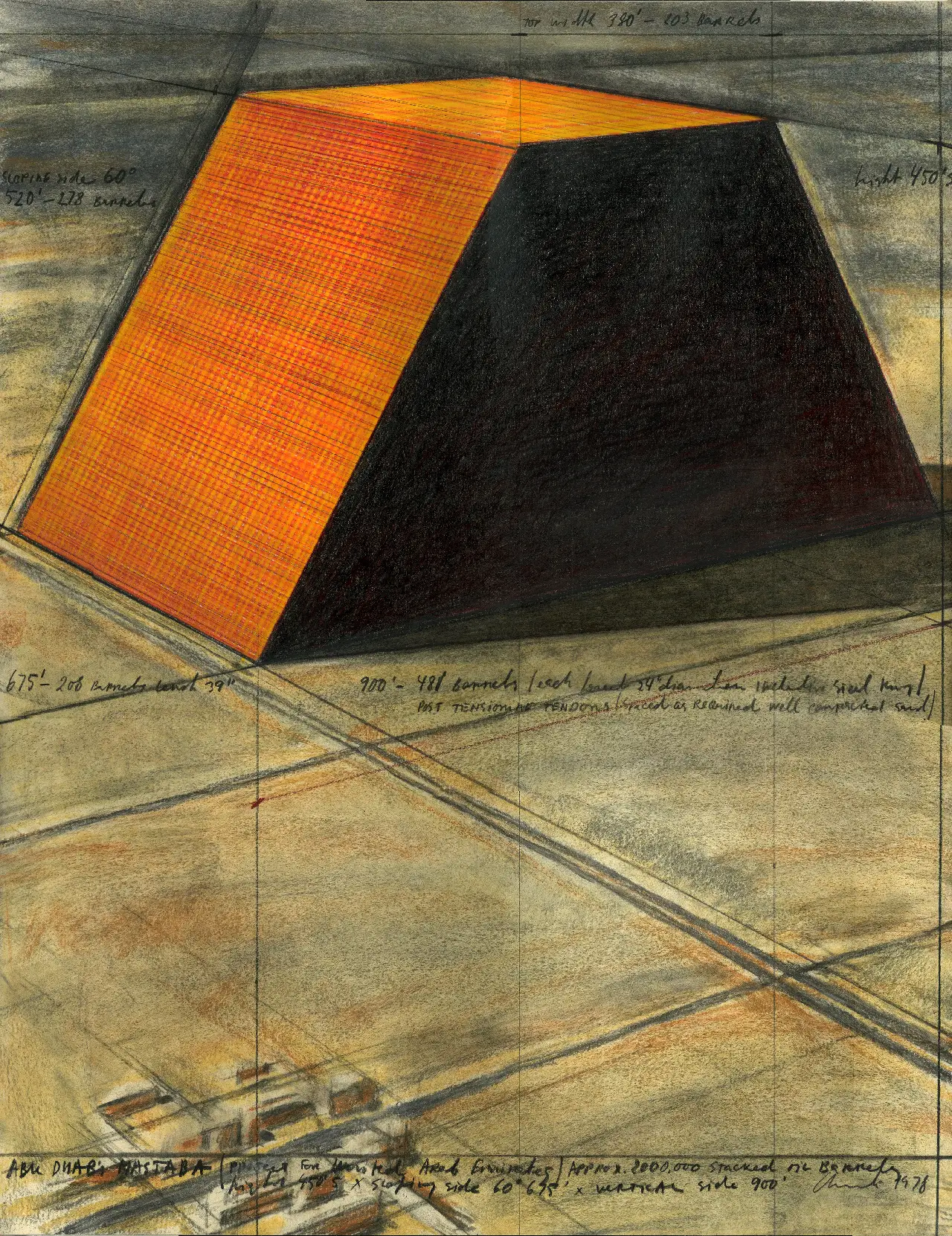
In 1977, the two artists conceived, for the United Arab Emirates, the largest sculpture project then envisioned: a monumental Mastaba, larger than the Great Pyramid of Khufu or St Peter’s Basilica in Rome
According to Christo: “The project is meant to intrigue society… we devote our energy to achieving a totally irrational objective; that is where the essence of our work lies”
(6).
He added: “I believe our work brings together elements from several artistic disciplines. It is not drawing, painting, sculpture, or architecture, but all of these together”
The two artists devoted considerable time to this Mastaba between 1979 and 1983.
After the project had faded from view, Christo gave it fresh momentum in 2018, as the Serpentine Gallery in London marked 60 years of barrel-based creations with the exhibition “Christo and Jeanne-Claude: Barrels and The Mastaba, 1958‑2018”
The London Mastaba, installed in the heart of Hyde Park, was meant to float on the Serpentine for a single summer: from 18 June to 23 September 2018 (9). Developed between 2016 and 2018, the project drew in particular on the one planned for Lake Michigan (1968). Covering 1% of the Serpentine, rising to more than 20 meters, it comprised 7 506 barrels in red, blue, and mauve—55 times fewer than the Abu Dhabi project.
The Abu Dhabi Mastaba will rise to 150 meters, on a rectangular base measuring 300 meters in length by 225 meters in depth—i.e., 67 500 m²— and will include 410 000 multicolored oil barrels, forming a mosaic of vivid, shimmering color in dialogue with Islamic architecture (10). It is intended to leave a lasting mark on the desert landscape of Liwa, where some of the most striking scenes of Star Wars, Episode VII: The Force Awakens (2015) were filmed.
Christo and Jeanne-Claude resumed studies from 2007 onward.
To realize the project of a lifetime, four independent engineering teams were asked to envision the load-bearing structure.
The solution proposed by Hosei University’s team in Japan prevailed: a steel-pylon framework whose volume is equivalent to four times that of the Eiffel Tower, weighing more than 50 000 tonnes
(11).
Since 2012, PricewaterhouseCoopers has analyzed the social and economic benefits of this gigantic Mastaba, which would become the only project by the couple to be made permanent in situ
“[Christo] also thinks of the Mastaba in its original meaning. Mastaba is a very ancient word, older than the word ‘pyramid’—a word that existed long ago and that comes, 6,000 or 7,000 years back, from the oldest city of Mesopotamia. It was a kind of massive bench with two sloping sides and two vertical sides. Later the Egyptians adopted the word to designate funerary monuments.” (13) The meaning that matters here is its original one.
For Christo: “The (original) Mastaba is very beautiful; it is a monument, a thrust of forces. When you stand at the side and look at the diagonal walls, you feel the whole structure is about to explode. It is a very different perception from what pyramids produce…” (14) The Abu Dhabi Mastaba is… “a sculpture-architecture” (15). The chosen location is extraordinary: in the western region (Al Gharbia), about 160 km from Abu Dhabi, near the Liwa oasis. The site comprises a plateau and a valley, allowing the structure to be viewed from different levels. The project includes the Mastaba itself, as well as a protected zone of 20 km2 around it, preventing low-quality construction from encroaching.
Footnotes
- First Mastaba-shaped sculpture realized in Cologne in 1961, in the context of an exhibition at Haro Lauhus. ↩
- “Iron Curtain”: intervention on rue Visconti, executed on the opening night of Christo’s exhibition at Pierre Restany’s gallery on 27 June 1962, then dismantled after nocturnal photographs were taken. ↩
- Move to New York: 1964. ↩
- Chronological markers: port of Cologne (1961) and the Institute of Contemporary Art, Philadelphia (1968), within the trajectory of Mastaba projects. ↩
- Monumental Mastaba project for the United Arab Emirates (conceived in 1977), presented as the largest sculpture project then envisioned. ↩
- Source excerpt: interview with Christo, Fondation Maeght exhibition catalogue, 2016, p. 48 ff. ↩
- Ibid. ↩
- Exhibition “Christo and Jeanne-Claude: Barrels and The Mastaba, 1958‑2018,” Serpentine Gallery, London—cited here as the context for renewed visibility in 2018. ↩
- Guillaume Fournier, “Christo installs a floating Mastaba in the middle of Hyde Park,” Le Monde, 20 June 2018. ↩
- Roxana Azimi, “Christo’s Mastaba, a pharaonic dream in the desert of the United Arab Emirates,” Le Monde, 03 September 2021. ↩
- Structural data (Hosei University team, steel pylons, volumetric equivalence, overall weight) as stated in the text provided. ↩
- PricewaterhouseCoopers: analysis of social and economic benefits since 2012, as stated in the text provided. ↩
- Source excerpt: interview with Christo, Fondation Maeght exhibition catalogue, 2016, p. 48 ff. ↩
- Ibid. ↩
- Ibid. ↩
Bibliography
- “Christo and Jeanne-Claude, The Mastaba — Project for United Arab Emirates. A Work in Progress,” exhibition catalogue, Galerie Guy Pieters, 21 July‑15 September 2007.
- “Christo and Jeanne-Claude, The Mastaba — Project for Abu Dhabi UAE,” Cologne, Taschen, 2012.
- “Christo and Jeanne-Claude: Barils — Barrels,” exhibition catalogue, Fondation Maeght, 4 June‑27 November 2016.
- Guillaume Fournier, “Christo installs a floating Mastaba in the middle of Hyde Park,” Le Monde, 20 June 2018.
- Roxana Azimi, “Christo’s Mastaba, a pharaonic dream in the desert of the United Arab Emirates,” Le Monde, 03 September 2021.